Updated CI/CD for KiCad 9 and Gitlab
Introduction
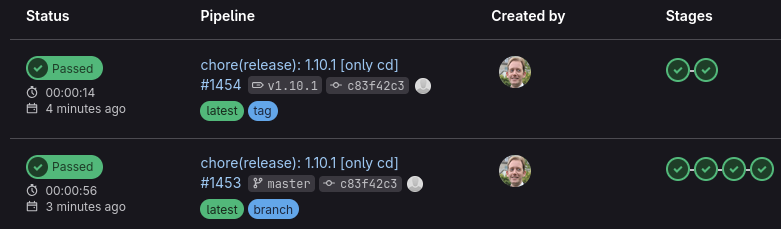
Here are some updates I have made since my original post about using KiCad with CI/CD. It is now using a kicad 9 docker image (ghcr.io/inti-cmnb/kicad9_auto:latest) and runs on the latest gitlab.
Auto adding date and version to PCB/Schematic
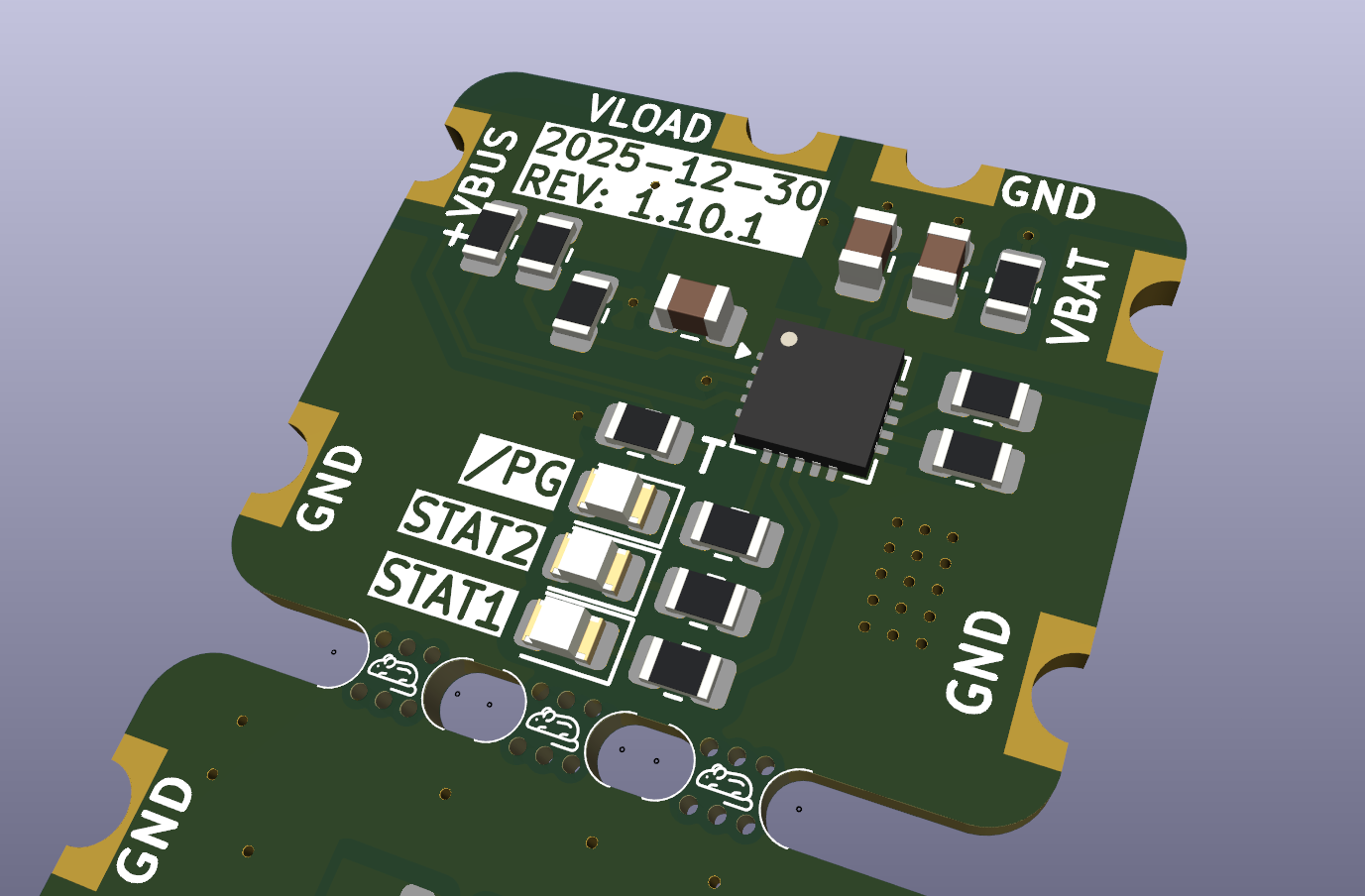
I have added a small change to my CI file to replace the Revision and Date in the Schematic and PCB. This way I will always know exactly which version I ordered at the FAB, as it’s auto-tagged in GitLab and printed on the PCB.
...
# exports the Version and Date into variables
    - export VERSION=`cat VERSION.txt` && echo ${VERSION}
    - export CURRENT_DATE=`date +'%Y-%m-%d'` && echo ${CURRENT_DATE}
# simple sed replace in the schematic and PCB files
    - sed -i "s/\t(rev \"[^\"]*\")/\t(rev \"${VERSION}\")/g" *.kicad_pcb
    - sed -i "s/\t(rev \"[^\"]*\")/\t(rev \"${VERSION}\")/g" *.kicad_sch
    - sed -i "s/\t(date \"[^\"]*\")/\t(date \"${CURRENT_DATE}\")/g" *.kicad_pcb
    - sed -i "s/\t(date \"[^\"]*\")/\t(date \"${CURRENT_DATE}\")/g" *.kicad_sch
# after this I run kibot to generate all the outputs
...
# also add schematic and PCB to the artifacts
# and in the .releaserc.yml so they get commited
  artifacts:
    when: always
    paths:
      - Fabrication/
      - "*.kicad_pcb"
      - "*.kicad_sch"
...
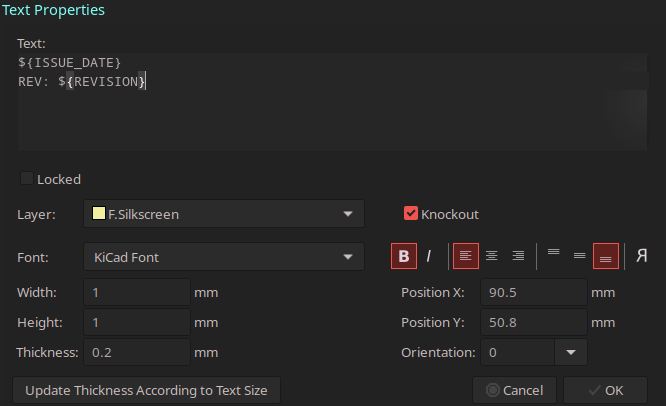
In Kicad I use the page variables in the text field.
Added LCSC part numbers to iBom
To make human pick and placing easier, I have added the LCSC part numbers to my iBom. This only required a small change to the configuration.
preflight:
  update_xml: true # needed to get the LCSC field

outputs:
  - name: ibom
    comment: Interactive BOM
    type: ibom
    dir: Fabrication/ibom
    options:
      dark_mode: true
      name_format: "index"
      extra_fields: 'LCSC' # extra field
      checkboxes: 'Placed' # I only want the placed checkbox
Auto generating BOM labels
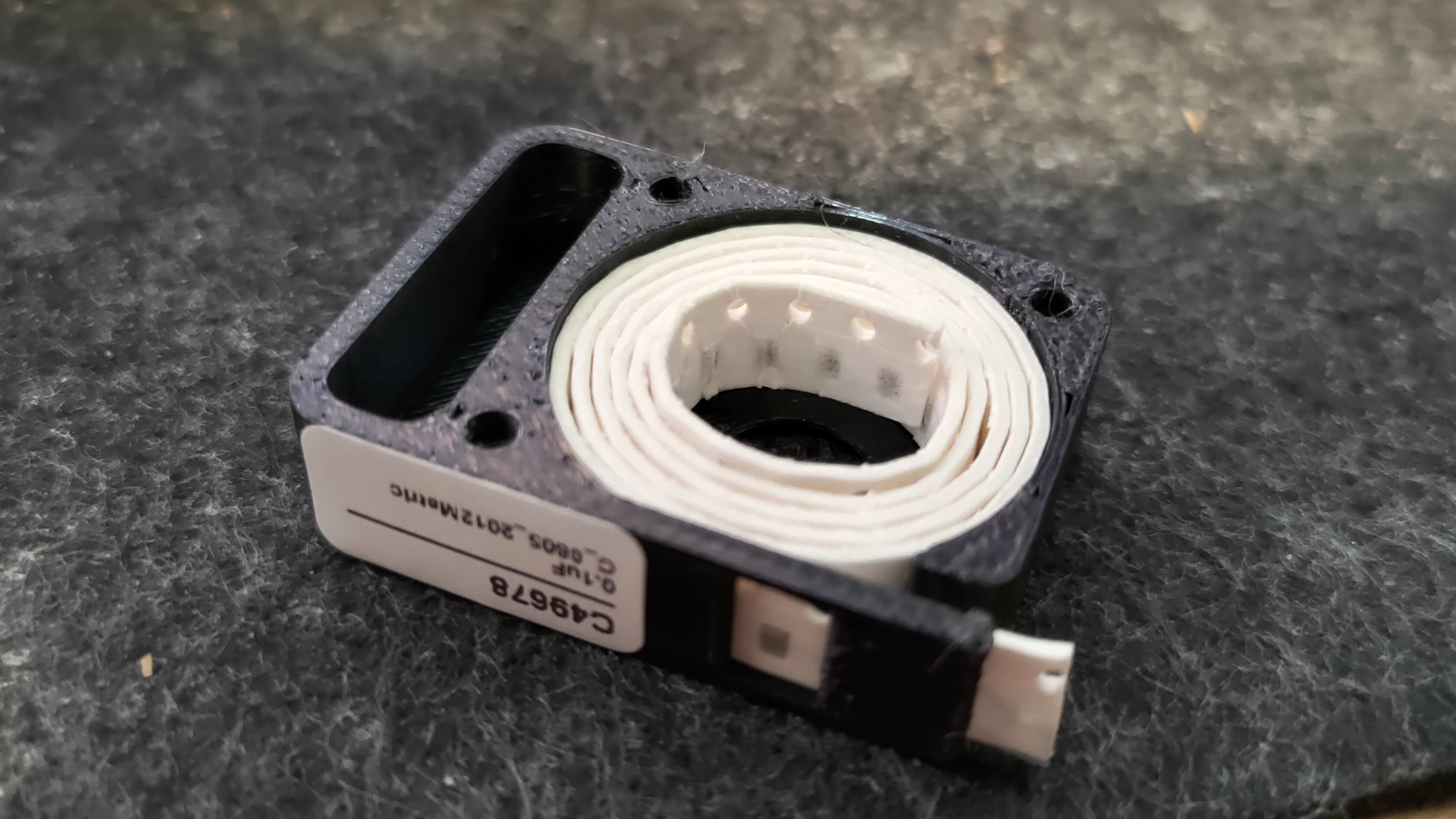
I usually order the BOM with the PCB, and I then have a box full of SMD components for a specific project. To make this easier to use than having to go through each bag every time I want to place a component, I have started to print these SMD tape holders. They are small and make it easier to remove the tape.
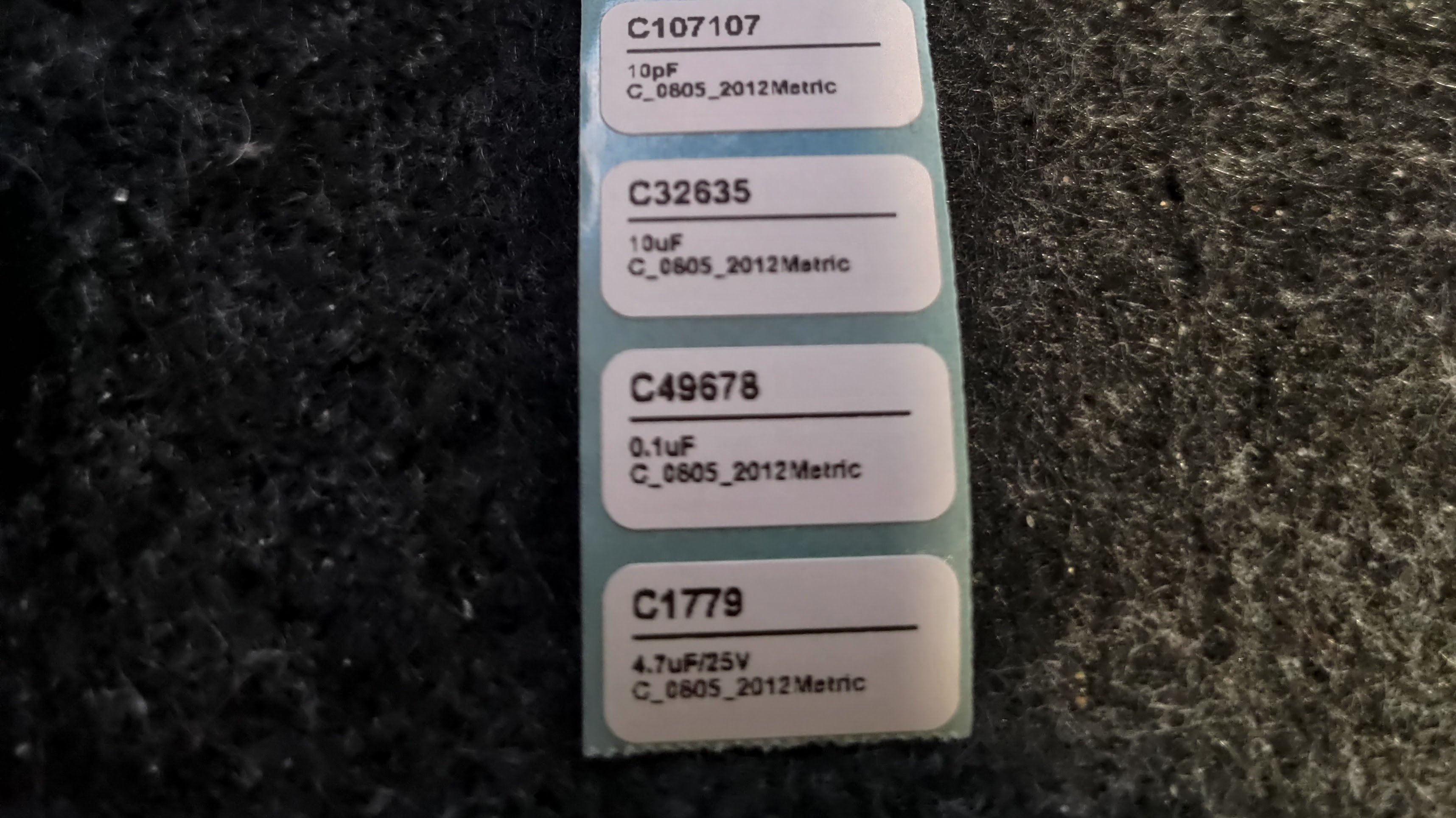
I used to manually import a CSV of the part numbers and then print those out, but I figured I might as well just write a small script to do this. Sadly, kibot can’t print custom templates, It is possible now to do this directly with kibot (Thank you @set-soft)
Using the current dev image of kibot (ghcr.io/inti-cmnb/kicad9_auto:dev) you can generate the labels directly via:
output.kibot.yaml
  - name: basic_bom_labels
    comment: BoM labels
    type: bom_labels
    dir: Fabrication/Labels
    options:
      bom: bom_labels

  - name: bom_labels
    comment: BoM to Print Labels
    type: bom
    run_by_default: false
    dir: Fabrication/Labels
    options:
      format: CSV
      output: bom_labels.%x
      group_fields:
      - LCSC
      sort_style: ref
      columns:
      - LCSC
      - Value
      - Footprint
      csv:
        hide_pcb_info: true
        hide_stats_info: true
Alternatively a simple Python script can manage it as well. You do have to install a Python library which is not included by default in the ghcr.io/inti-cmnb/kicad9_auto:latest image.
I first generate a CSV of the data I need in kibot:
output.kibot.yaml
  - name: bom_labels
    comment: "Print Labels"
    type: bom
    dir: Fabrication/Labels
    options:
      format: KICAD
      group_fields: ['LCSC']
      sort_style: ref
      columns:
        - field: LCSC
          name: Part
        - field: Value
        - field: Footprint
I then trigger the script in my pipeline:
.gitlab-ci.yml
    - apt-get update -y && apt-get install -y python3-reportlab
    - python3 configs/gen-labels.py 'Fabrication/Labels/*.csv'
The result is a PDF with one label per page. I can then send this to my cheap label printer HZ-D108B (via my phone; Linux support is garbage) and print off the 20mm x 10mm labels. They fit perfectly on the 3D printed part or one of these SMD storage boxes.
Multi-PCB per project support
My old CI script did not support multiple PCBs in the same project. I have fixed this now.
Full configurations
.gitlab-ci.yml
stages:
  - fetch-version
  - testing
  - gen_fab
  - publish
  - deploy

variables:
  KICAD9_3DMODEL_DIR: "$CI_PROJECT_DIR/packages3d"
  KICAD_USER_TEMPLATE_DIR: "$CI_PROJECT_DIR/templates"

# https://levelup.gitconnected.com/semantic-versioning-and-release-automation-on-gitlab-9ba16af0c21
fetch-semantic-version:
  image: node:24
  stage: fetch-version
  only:
    refs:
      - master
      - alpha
      - /^(([0-9]+)\.)?([0-9]+)\.x/ # This matches maintenance branches
      - /^([0-9]+)\.([0-9]+)\.([0-9]+)(?:-([0-9A-Za-z-]+(?:\.[0-9A-Za-z-]+)*))?(?:\+[0-9A-Za-z-]+)?$/ # This matches pre-releases
  script:
    - npm install @semantic-release/gitlab @semantic-release/exec @semantic-release/changelog @semantic-release/git -D
    - npx semantic-release --generate-notes false --dry-run
  artifacts:
    paths:
      - VERSION.txt
  tags:
    - docker

generate-non-semantic-version:
  stage: fetch-version
  except:
    refs:
      - master
      - alpha
      - /^(([0-9]+)\.)?([0-9]+)\.x/ # This matches maintenance branches
      - /^([0-9]+)\.([0-9]+)\.([0-9]+)(?:-([0-9A-Za-z-]+(?:\.[0-9A-Za-z-]+)*))?(?:\+[0-9A-Za-z-]+)?$/ # This matches pre-releases
  script:
    - echo build-$CI_PIPELINE_ID > VERSION.txt
  artifacts:
    paths:
      - VERSION.txt
  tags:
    - docker

tests:
  image: ghcr.io/inti-cmnb/kicad9_auto:latest
  stage: testing
  script:
    - pwd
    - |
      for pcb in *.kicad_pcb; do
        if [[ -f "$pcb" ]]; then
          echo "Testing PCB: $pcb"

          # Get the base name without extension
          base_name="${pcb%.kicad_pcb}"
          sch_file="${base_name}.kicad_sch"

          if [[ -f "$sch_file" ]]; then
            echo "  Found matching schematic: $sch_file"
            # Both files exist, use project mode
            kibot -c test.kibot.yaml -e "$pcb"
          else
            echo "  No schematic found, using --no-check-sch"
            # No schematic, skip the check
            kibot -c test.kibot.yaml -e "$pcb" --no-check-sch
          fi
        fi
      done
  tags:
    - docker

pcb_outputs:
  image: ghcr.io/inti-cmnb/kicad9_auto:latest
  stage: gen_fab
  script:
    - export VERSION=`cat VERSION.txt` && echo ${VERSION}
    - export CURRENT_DATE=`date +'%Y-%m-%d'` && echo ${CURRENT_DATE}
    - sed -i "s/\t(rev \"[^\"]*\")/\t(rev \"${VERSION}\")/g" *.kicad_pcb
    - sed -i "s/\t(rev \"[^\"]*\")/\t(rev \"${VERSION}\")/g" *.kicad_sch
    - sed -i "s/\t(date \"[^\"]*\")/\t(date \"${CURRENT_DATE}\")/g" *.kicad_pcb
    - sed -i "s/\t(date \"[^\"]*\")/\t(date \"${CURRENT_DATE}\")/g" *.kicad_sch
    - |
      for pcb in *.kicad_pcb; do
        if [[ -f "$pcb" ]]; then
          echo "Processing PCB: $pcb"

          # Get the base name without extension
          base_name="${pcb%.kicad_pcb}"
          sch_file="${base_name}.kicad_sch"

          if [[ -f "$sch_file" ]]; then
            echo "  Found matching schematic: $sch_file"
            # Both files exist, use project mode
            kibot -c output.kibot.yaml -b "$pcb"
            kibot -c jlcpcb.kibot.yaml -b "$pcb"
            kibot -c pcbway.kibot.yaml -b "$pcb"
          else
            echo "  No schematic found, using --no-check-sch"
            # No schematic, skip the check
            kibot -c output.kibot.yaml -b "$pcb" --no-check-sch
            kibot -c jlcpcb.kibot.yaml -b "$pcb" --no-check-sch
            kibot -c pcbway.kibot.yaml -b "$pcb" --no-check-sch
          fi
        fi
      done
    - apt-get update -y && apt-get install -y python3-reportlab
    - python3 configs/gen-labels.py 'Fabrication/Labels/*.csv'
  only:
    refs:
      - master
      - alpha
      # This matches maintenance branches
      - /^(([0-9]+)\.)?([0-9]+)\.x/
      # This matches pre-releases
      - /^([0-9]+)\.([0-9]+)\.([0-9]+)(?:-([0-9A-Za-z-]+(?:\.[0-9A-Za-z-]+)*))?(?:\+[0-9A-Za-z-]+)?$/
  artifacts:
    when: always
    paths:
      - Fabrication/
      - "*.kicad_pcb"
      - "*.kicad_sch"
  tags:
    - docker

release:
  stage: publish
  image: node:24
  only:
    refs:
      - master
      - alpha
      # This matches maintenance branches
      - /^(([0-9]+)\.)?([0-9]+)\.x/
      # This matches pre-releases
      - /^([0-9]+)\.([0-9]+)\.([0-9]+)(?:-([0-9A-Za-z-]+(?:\.[0-9A-Za-z-]+)*))?(?:\+[0-9A-Za-z-]+)?$/
  script:
    - npm install @semantic-release/gitlab @semantic-release/exec @semantic-release/changelog @semantic-release/git -D
    - npx semantic-release
  tags:
    - docker
output.kibot.yaml
kibot:
  version: 1

globals:
  resources_dir: configs

preflight:
  update_xml: true

variants:
  - name: rotated
    comment: "Just a place holder for the rotation filter"
    type: kibom
    variant: rotated
    pre_transform: _rot_footprint

outputs:
  - name: ibom
    comment: Interactive BOM
    type: ibom
    dir: Fabrication/ibom
    options:
      dark_mode: true
      name_format: "index"
      extra_fields: 'LCSC'
      checkboxes: 'Placed'

  - name: "SchPrint"
    comment: "Print schematic PDF"
    type: pdf_sch_print
    dir: Fabrication/PDFs
    options:
      color_theme: dracula
      background_color: true

  - name: bom_labels
    comment: "Print Labels"
    type: bom
    dir: Fabrication/Labels
    options:
      format: KICAD
      group_fields: ['LCSC']
      sort_style: ref
      columns:
        - field: LCSC
          name: Part
        - field: Value
        - field: Footprint
.releaserc.yml
---
plugins:
  - "@semantic-release/commit-analyzer"
  - - "@semantic-release/release-notes-generator"
    - linkReferences: false
      linkCompare: false
  - - "@semantic-release/exec"
    - verifyReleaseCmd: "echo ${nextRelease.version} > VERSION.txt"
  - - "@semantic-release/changelog"
    - changelogFile: CHANGELOG.md
  - - "@semantic-release/git"
    - assets:
        - 'CHANGELOG.md'
        - 'VERSION.txt'
        - 'Fabrication/'
        - '*.kicad_pcb'
        - '*.kicad_sch'
      message: "chore(release): ${nextRelease.version} [only cd]\n\n${nextRelease.notes}"
  - "@semantic-release/gitlab"

branches:
  - "master"
  - "+([0-9])?(.{+([0-9]),x}).x"
  - name: "alpha"
    prerelease: "alpha"
configs/gen-labels.py
#!/usr/bin/env python3
import csv
import sys
import os
import glob
from pathlib import Path
from reportlab.lib.pagesizes import mm
from reportlab.pdfgen import canvas

def csv_to_pdf_rows(csv_file, pdf_file):
    # Custom page size: 20mm x 10mm
    PAGE_WIDTH = 20 * mm
    PAGE_HEIGHT = 10 * mm

    c = canvas.Canvas(pdf_file, pagesize=(PAGE_WIDTH, PAGE_HEIGHT))

    # Read CSV data
    with open(csv_file, 'r') as f:
        reader = csv.reader(f)
        rows = list(reader)

    if len(rows) < 3:
        print(f"CSV file has only {len(rows)} rows, but we need at least 3 to skip first 2")
        return

    # Skip first 1 row: row 0 (empty) and row 1 (header line)
    data_rows = rows[1:]

    print(f"Processing {len(data_rows)} data rows (skipped first 2 rows)")

    # Create one page per row
    for row_index, row in enumerate(data_rows):
        # Start new page (don't need c.showPage() for first page, but will add for consistency)
        if row_index > 0:
            c.showPage()

        # Draw first column as header at top in larger font
        if row:  # Check if row has at least one column
            first_cell = str(row[0])
            if len(first_cell) > 25:  # Allow longer text for header
                first_cell = first_cell[:22] + "..."

            c.setFont("Helvetica-Bold", 6)  # Larger font for first column as header
            c.drawString(2 * mm, PAGE_HEIGHT - 3 * mm, first_cell)

        # Draw separator line
        c.line(2 * mm, PAGE_HEIGHT - 4 * mm, PAGE_WIDTH - 2 * mm, PAGE_HEIGHT - 4 * mm)

        # Draw remaining columns below in smaller font
        c.setFont("Helvetica-Bold", 4)  # Smaller font for other columns
        y_position = PAGE_HEIGHT - 6 * mm  # Start below separator

        # Start from column 1 (second column)
        for col_index in range(1, min(3, len(row))):  # Limit to 2 more columns
            cell = row[col_index]
            text = str(cell)
            if len(text) > 25:
                text = text[:22] + "..."

            c.drawString(2 * mm, y_position, text)
            y_position -= 1.5 * mm

            if y_position < 1 * mm:
                break

    c.save()
    print(f"PDF saved as {pdf_file} with {len(data_rows)} pages (one per data row)")

def process_csv_files(input_pattern):
    """Process CSV files matching the input pattern"""
    # Expand the pattern to get all matching files
    csv_files = glob.glob(input_pattern)

    if not csv_files:
        print(f"No CSV files found matching pattern: {input_pattern}")
        return

    print(f"Found {len(csv_files)} CSV file(s) to process:")

    for csv_file in csv_files:
        # Create output filename: same directory, same base name, .pdf extension
        input_path = Path(csv_file)
        pdf_file = input_path.with_suffix('.pdf')

        print(f"\nProcessing: {csv_file}")
        print(f"Output will be: {pdf_file}")

        try:
            csv_to_pdf_rows(csv_file, str(pdf_file))
            print(f"✓ Successfully created {pdf_file}")
        except Exception as e:
            print(f"✗ Error processing {csv_file}: {e}")

if __name__ == "__main__":
    if len(sys.argv) != 2:
        print("Usage: python3 gen-labels.py <input_pattern>")
        print("Examples:")
        print("  python3 gen-labels.py Fabrication/Labels/*.csv")
        print("  python3 gen-labels.py data.csv")
        print("  python3 gen-labels.py *.csv")
        print("  python3 gen-labels.py path/to/files/*.csv")
        sys.exit(1)

    input_pattern = sys.argv[1]
    process_csv_files(input_pattern)